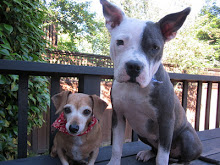
 An Oakland police officer found this injured Shepherd mix on the side of the road late on Thanksgiving night. It appeared that he had been hit by a car and left to die. The OPD officer immediately rushed the pooch to an emergency animal hospital, where the veterinarians on duty determined that he had two badly broken legs. Friends of Oakland Animal Services (FOAS) was contacted, and agreed to help cover the pup's medical expenses, including his x-rays. When German Shepherd Rescue of Northern California stepped in and offered to provide foster care and find him an adoptive home, the lucky boy's fortune turned yet again. What a wonderful expample of human kindness at work, with folks willing to pitch in on Thanksgiving night in order to save a deserving dog's life!
Wednesday, November 30, 2011
A Thanksgiving Rescue
An Oakland police officer found this injured Shepherd mix on the side of the road late on Thanksgiving night. It appeared that he had been hit by a car and left to die. The OPD officer immediately rushed the pooch to an emergency animal hospital, where the veterinarians on duty determined that he had two badly broken legs. Friends of Oakland Animal Services (FOAS) was contacted, and agreed to help cover the pup's medical expenses, including his x-rays. When German Shepherd Rescue of Northern California stepped in and offered to provide foster care and find him an adoptive home, the lucky boy's fortune turned yet again. What a wonderful expample of human kindness at work, with folks willing to pitch in on Thanksgiving night in order to save a deserving dog's life!

Sunday, November 20, 2011
Old Souls In Need Of Forever Families
Fluffy

Cider

Precious

Meika

Casper
 Between the tough economy and the pet overpopulation crisis, animal shelters across the country are overflowing with dogs, cats, and critters of all shapes and sizes. While all homeless animals are worthy of adoption, senior pets are often the ones at greatest risk in shelters. November is Adopt-A-Senior-Pet Month, and I wanted to share some compelling reasons to open your heart and home to an old soul. The five dogs shown here - Fluffy, Cider, Precious, Meika, and Casper - are all available for adoption through Muttville Senior Dog Rescue. If their portraits aren't quite enough to convince you that you could benefit from having a senior canine in your life, here is OldDog Haven's list of ten reasons why adopting a mature pooch is a great idea:
Sunday, November 13, 2011
Sparky The Deaf Dachshund Finds A Home Among Deaf Students
 The students at the Missouri School for the Deaf know what it's like to be ostracised due to a hearing impairment. That's why Sparky, the resident Dachshund, fits in so well. He's deaf, too.
Before Sparky came to live at the school earlier this year, he was in danger of being euthanized because he was born without the ability to hear. Fortunately, Sparky made it into the Puppies for Parole program, an initiative of the Missouri Department of Corrections where inmates train rescue dogs in order to make them more adoptable. When the eight week prison training program was complete, the inmates decided they wanted Sparky to live with deaf youth.
The superintendent of the Missouri School for the Deaf, Barbara Garrison, jumped at the chance to introduce Sparky to her students. "He fits perfectly here," she told the Fulton Sun. "Because these kids hear all the time what they can't do. We try to tell them what they can do. He likes his new deaf family here."
Sparky responds to commands in American Sign Language, and knows "sit," "stay," "lie down" and other basics as well as any pooch. With help from the students, he is learning more all the time.
Sparky has made such a positive impact at the school that another deaf four-legged friend from Puppies for Parole may be joining him in the near future.
Monday, November 7, 2011
Helping Your Dog Rebound After An Amputation
 Keeping Your Three-Legged Dog Healthy
by Dana Standish
Originally appearing in The Bark, Issue #37, Jul/Aug 2006
Three legs to stand on
A really expensive car can go from zero to 60 in less than six seconds, but that car would have nothing on Harvey, a seven-month-old Mastiff/Husky mix, who went from being an $85 dog to a $2,000 dog in less than four hours. That’s how long it took Harvey to be adopted from the Tacoma Humane Society, perform a cursory inspection of his new home on the fourth floor of an apartment building in Seattle, race out onto the outside terrace to check out the dog house and vault over the surrounding hip wall. Harvey hit an awning, landed on the sidewalk and ended up in the emergency room with a badly broken right rear leg that later had to be amputated. “The vet said they usually try to pin the leg first,” says Lindsey Votava, who had fallen in love with Harvey on Petfinder.com, “but with the extent of Harvey’s injury it would have been like trying to put together a bag of potato chips.”
Votava and her husband, Leif Dalan, were clear that having Harvey’s leg amputated would give him the best chance of recovery. Trying to save the leg would have doubled their vet bill and meant they would have had to immobilize Harvey for up to eight weeks, which would have violated several of the laws of physics. “Harvey walked up the stairs after his surgery,” recalls Votava, and never missed a beat. He maintains a wicked Frisbee schedule at the dog park and does everything a four-legged dog does, except “he can’t scratch his ear.” They give him glucosamine for his joints and try to keep him from overexercising so that he doesn’t injure his remaining limbs. “We have to think for him,” Votava says. “That jumping off the roof was how he is. He’s a totally go, go, go kind of dog.”
It’s not unusual these days for a dog to lose a leg, generally for one of two reasons: they suffer some sort of accident or trauma, like Harvey’s, or they develop bone cancer or other bone disease. The latter is what happened to Bernie, an eight-year-old Rottweiler whose left front leg was amputated in January. Bernie was recovering nicely from surgery to her anterior cruciate ligament (ACL) when her guardian, Tom Tilden, noticed she was limping and not bouncing back as quickly as he had expected. An X-ray showed bone cancer. “The first vet we consulted suggested giving her painkillers until the pain got to be too bad and then having her put down,” says Tilden. “We found another doctor.”
Bernie’s situation is completely different from Harvey’s. Harvey is lean and lost a rear leg while he was still a puppy; he was able to adjust immediately. Bernie is a stockier breed and lost a front leg relatively late in her life. “The front leg accounts for approximately 70 percent of the dog’s strength and balance,” says Sheila Wells, a hydrotherapist in Seattle who works with Bernie several times per week. “That is why front-leg amputees often have a more difficult time adjusting to their new state. The rear can follow but the front has to lead.”
Keeping the Tripod Dog Healthy
Wells, who has been operating her canine hydrotherapy studio, Wellsprings, since 1995, has a special fondness for three-legged dogs. When she was a child, her uncle had a Border Collie, Trixie, whose front leg had to be amputated after she got into a jam with a poisonous jellyfish in Sooke Harbour, British Columbia. “My uncle’s veterinarian told me, ‘Swim her,’” says Wells. Wells saw the benefits of this type of therapy, and a career was born. “Trixie lived another 10 years, during which she raced around like the wind.”
Wells says that in her experience, most three-legged dogs are “very highly functioning.” Some dogs do better than others, depending on their size (smaller dogs have an easier time), age and other physical problems. “The biggest challenge a dog faces when it loses a limb,” says Wells, “is that it has to relearn proprioception, which means it needs to get a new idea of where its body is in space and how to balance; it’s like the bubble in a level.” The most important challenge for tripod-dog owners, she says, is to protect the remaining limbs; often people will let the dog overdo it, and that ends up putting undue stress on the dog’s joints, which can lead to injuries and arthritis. She recommends that owners observe the following checklist to keep the three-legged dog healthy for as long as possible:
• Protect remaining limbs
• Put a sock/pad on the “elbow” of the remaining leg (to prevent calluses and pressure sores)
• Keep the dog’s weight down
• Take care of the dog’s skin and pads
• Exercise the dog regularly (walking is good; swimming is best)
• Assist or monitor the dog on stairs
• Monitor the dog’s activity level and don’t let him or her overdo it
• Give glucosamine, fish oils and other anti-inflammatory supplements
• Maintain a good diet and good overall health
• For front leg amputations, use a car seat harness with wide chest bands
• Invest in a “wheelchair,” if necessary, to help with mobility
How Many Tripods Are There?
It would be impossible to determine how many tripod dogs there are in the United States, says Sally Wortman, hospital administrator of Pets Unlimited, a major veterinary hospital and shelter in the San Francisco Bay area, though she estimates they do two to three amputations per month. Pets Unlimited treats approximately 50,000 animals per year. “We take in animals from other shelters, animals that don’t have many other opportunities,” says Wortman.
One of those animals was Wortman’s Clover, a one-and-a-half-year-old Pointer/Border Collie mix who arrived at the shelter with a badly broken right front leg that had to be amputated. “She was up and running the day after surgery,” says Wortman. “She’s a very athletic dog. She keeps up with the Greyhounds at the park. She’s inspiring to everyone who sees her.” Wortman says that she has noticed that people’s acceptance of three-legged dogs is growing. “Before, perhaps, people would have thought it was sad that she was missing a limb. But that has changed. I was recently at the dog park and met a couple whose baby had a paralyzed right arm. They said to me, ‘I wish we could get a three-legged dog so our child could grow up to think it was okay to be missing a limb.’”
“We always try to save the limb first,” says Thomas Mason, director of veterinary services at Pets Unlimited, “though sometimes this is much more expensive and requires more rehabilitation.” An amputation typically costs $1,200, while it may cost up to $3,000 to try to salvage the limb.
Before doing an amputation, a vet must decide if the dog is a good candidate. “We assess the animal’s overall physical condition. If the dog has arthritis in the other legs, for instance, he wouldn’t be such a good candidate. Amputation causes wear and tear on the other joints.” Many times, says Mason, a vet will end up taking off a dog’s entire leg, even if the trauma or the cancer is low down on the “ankle” joint. “Because of the way dogs walk, you end up with a lot of problems if you leave some of the limb. It would just get in the way. Most of the time, amputation is more cosmetically acceptable.”
Martin Kaufmann would like to see a change to this type of practice. Kaufmann, of www.OrthoPets.com, makes prosthetics and orthotics for both “two-legged and four-legged animals and any variation in the middle.” His goal is “to get the animal world up to speed with what we’re doing with humans.” He began his practice with animals four years ago, after a cousin’s Schnauzer suffered a stroke and lost the function in its right front leg. Kaufmann began studying animal anatomy books and learned that the muscle and bone terminology in dogs is almost exactly what it is in humans. Now, 30 percent of his practice is making artificial limbs and braces for animals, mostly dogs. “When three-legged dogs are brought to me, when they are amputated way up at the joint, there aren’t many options,” he says. Too often he sees animals who had cancer in the “wrist” joint.
“The vets tend to think of it as a useless limb and amputate way up at the top. That makes it almost impossible to build a prosthesis. We need at least one joint in order for the animal to be able to operate” with a prosthetic limb. Kaufmann explains that since this is a new field and he is one of only a few people doing this type of prosthetic work, not many vets know of this option. But he is trying to spread the word. “For limb preservation, it’s important to salvage as much of the limb as possible, or as many joints as possible.” If the limb has already been amputated at the top, he recommends having the dog use a cart to maintain the weight distribution on the leg that’s left. “Compounding forces on the remaining leg can cause arthritis from overuse. If the animal loses the remaining leg, what does it have left?”
Whether a dog loses a leg due to trauma or disease, most often he or she will bounce back and learn to adjust. As Sheila Wells points out, dogs don’t have the same stigma that we would have about losing a limb. “Some don’t ever notice their leg is missing,” she says. “Usually a leg that has been taken off has been painful for a long time and the dog is already used to not using that leg. When they get it removed, their whole demeanor changes because they can run around without being in pain. There’s no reason a three-legged dog has to be disabled.”
Wednesday, November 2, 2011
Pets With Disabilities Shine In Portrait Series By Photographer Carli Davidson

 From www.peoplepets.com
Photographer Carli Davidson was hanging out at an Oregon beach a few years ago when she saw a German shepherd playing fetch with his owner. The dog also happened to be in a wheelchair.
"The dog seemed perfectly happy, and they were happy hanging out with each other," Davidson says. "It gave me the idea that I could create something that showed people we should keep animals around."
So Davidson, whose work centers around animals, began the Pets with Disabilities Project, taking portraits of Portland-area pets that are blind or in wheelchairs, but are 100-percent happy.
"Aside from how I personally anthropomorphize these animals as being inspiring, they don't really act different than other animals," she says. "They're totally just cats and dogs. It's amazing to see how little they're affected by their disabilities." ___________________________________________________
"The dog seemed perfectly happy, and they were happy hanging out with each other," Davidson says. "It gave me the idea that I could create something that showed people we should keep animals around."
So Davidson, whose work centers around animals, began the Pets with Disabilities Project, taking portraits of Portland-area pets that are blind or in wheelchairs, but are 100-percent happy.
"Aside from how I personally anthropomorphize these animals as being inspiring, they don't really act different than other animals," she says. "They're totally just cats and dogs. It's amazing to see how little they're affected by their disabilities." ___________________________________________________
To learn more about Carli Davidson's Pets with Disabilities photo project, visit her website: www.carlidavidson.com
Subscribe to:
Posts (Atom)


 Posts
Posts

