Wednesday, June 29, 2011

Sunday, June 26, 2011
It's Official: Tulip Is Here To Stay!!!
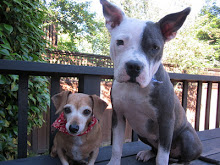
 When Tulip joined the fold as our foster puppy at the beginning of April, we had no idea that we would be permanently adopting her several months later. This sprightly little Pit Bull mix worked a special kind of magic, though, and we soon found ourselves completely smitten with her.
Having Tulip in the house has been a joy; she is the quintessential puppy through and through. She has a very happy spirit and makes friends with everyone that she meets - human and canine. She loves to chase after tennis balls and sticks, and she is especially fond of squeaky toys which she gleefully pursues all around the house and backyard during her frequent ecstatic bursts of energy.
It's great to see Tulip's lively side since she was extremely sick and dispirited when we first met her. She was suffering from an advanced case of Demodectic mange, and the poor girl barely had any fur at all. She also had a body-wide secondary infection, and her skin was bright pink and covered with scabs.
 Although her health has improved tremendously, her immune system is still weak and she needs daily antibiotics and regular medicated baths. Most of her fur has grown in now, but she still has a ways to go...
No dog will ever replace our Greta (or little Franny, who touched us greatly even though we had her for such a short time), but Tulip has introduced a wonderful component of joyfulness into our lives.
Three-legged Dewey seems pleased with her company, too, and they have struck up quite a partnership! They can often be found cuddled up together (using each other as pillows), and they share a mutual love of food.
 As someone who has primarily had small dogs, it is a new and interesting experience to be a Pit Bull guardian. Unfortunately, the negative myths about Pit Bulls abound, and we have had some nasty comments about Tulip. What we have come to realize is that snide remarks and uniformed reactions are inevitable, even in a place like the San Francisco Bay Area, and so Michael and I are eager for Tulip to be a sterling example of all the wonderful qualities that a Pit Bull can possess. In all honesty, she is far better behaved that little 12 pound Dewey!
Our Pack Pit Bull Rescue has put together a good fact sheet that debunks many of the common misconceptions about our pittie friends:
The Truth About Pit Bulls
Pit Bulls Don’t Feel Head or Neck Pain: This is not true. Pit Bulls feel pain like other breeds do. Being tenacious, they will carry on a task until it's completed and push through the pain but they still experience pain just like other breeds of dogs.
Pit Bulls Are Human Attack Dogs: A Pit Bull with a correct temperament is very human friendly and seeks human affection. Pit Bulls love to be touched and handled by humans. As Pit Bulls are terriers they can be dog intolerant. This can vary as much within the breed as it does among all breeds and is very manageable. Note: Dog intolerance is a very different behavior from human aggression. They are not interchangeable.
Pit Bulls Have Locking Jaws: The jaws of a Pit Bull work in the same way as other canines. A Pit Bull is tenacious and willful and he may hold on as a result of his willfulness and tenacity but not because his jaws are physically “designed” to lock. Other breeds may also be very likely to bite and hold on but there is no evidence that any breed has locking jaws.
Pit Bulls Are Not Safe Around Children: The only thing to be concerned about with a temperamentally correct, well-socialized Pit Bull is that he may become very excited around children and knock them over trying to lick them! This is also very easily resolved through training. Pit Bulls generally love attention from children. Even poking, ear pulling type attention will make most Pit Bulls very happy. Of course, one should never leave their child unattended with any dog of any breed, ever. Also, children should be taught how to properly treat pets in the home. Any dog of any breed should be continually socialized to children, adults, and animals throughout his life, including the Pit Bull.
Pit Bulls Are Taught To Be Dog Aggressive: All canines can become defensive if they feel threatened. This is how dogs have survived for eons. They can also lack confidence in social skills with other dogs when not well-socialized and become defensive and fight. Therefore, they don't need training to fight. They can just be set up to fight in certain environments and then reinforced for it. Additionally, Pit Bulls are Terrier dogs. All Terrier dogs tend be less willing to tolerate another dog's rude gestures. This is a very easily managed trait. We have found that our fight bust dogs are our best dogs ever! All dogs of all breeds must be well-socialized with other dogs from an early age, including Pit Bulls.
Pit Bulls that have scars on the head or leg area have been fought: Not necessarily. Maybe he got into it with a coyote or got caught in a chain link fence. There are many reasons why a Pit Bull or any breed of dog could have scars.
Pit Bulls Make Good Guard Dogs: False! Better get a guard dog for your Pit Bull!


Wednesday, June 15, 2011
A Happy Outcome In San Francisco For Two Blind Sea Lions
I first read about the saga of Silent Knight, a sea lion who was shot and blinded, back in December. Without a permanent home in captivity, he was facing possible euthanasia. My heart hurt at that prospect, but I held out hope that he would find a safe haven somewhere in the Bay Area, and thankfully, he did! Today Silent Knight lives with another blind sea lion named Henry at the San Francisco Zoo. Here's a story from the SF Chronicle about the happy outcome for this special pair...

Silent Knight and buddy find home at S.F. Zoo
By Carolyn Jones, San Francisco Chronicle
After 10 years, sea lions have returned to the San Francisco Zoo - in this case, two special-needs pinnipeds, one of whom made headlines in December when he was found struggling on a Sausalito beach, blinded by a gunshot wound to the head.
The 400-pound California sea lion, named Silent Knight for his quiet, dignified demeanor, is now a permanent resident of the zoo after he underwent treatment at the Marine Mammal Center and, because of his disability, was deemed unfit to be released into the wild.
The Marine Mammal Center does not have space to keep him permanently, and Silent Knight was in danger of euthanasia until the San Francisco Zoo stepped in. Zoo staff had read about Silent Knight's plight and arranged with the Marine Mammal Center to adopt the regal sea lion.
Accompanying Silent Knight was Henry, a young, rambunctious and blind sea lion recently brought from Humboldt County. Henry and Silent Knight shared an enclosure at the Marine Mammal Center and had become pals.
"We knew from the get-go this would be a huge undertaking, financially and because of their medical needs," said Debbie Marrin, sea lion keeper at the zoo. "But we wanted to help out. How could you not help out? These guys would have been euthanized."
Silent Knight and Henry made their public debut Friday, doing what sea lions do best: lounging on rocks, gulping herring and taking the occasional dip.
A sign alongside their enclosure explains their story, encouraging the public to respect sea lions, not shoot them.
"I love that these two now have a purpose in life," said Shelbi Stoudt, stranding manager at the Marine Mammal Center. "And I'm happy Silent Knight is staying local. This way we can visit him."
Silent Knight was spotted listless and emaciated on Swede's Beach in Sausalito on Dec. 8 and rescued by Marine Mammal Center staff. His right eye was blown out, and X-rays showed five fragments of buckshot in his brain, mouth and eyes. After a few days it was apparent he was blind in both eyes but was otherwise healthy.
No one knows who shot Silent Knight, but in the past few years the center has seen a rash of fishermen-related sea lion shootings. Sea lions like to eat salmon, and several years of limited salmon runs have left fishermen and sea lions competing for fish.
In 2010, the Marine Mammal Center saw 19 sea lions with gunshot wounds. One of those was Sgt. Nevis, a 650-pound sea lion rescued from the Sacramento River with his nose shot off. Veterinarians at the Marine Mammal Center and Six Flags Discovery Kingdom in Vallejo performed what's thought to be the world's first reconstructive surgery on a sea lion, fixing Sgt. Nevis' nose so he could swim underwater again.
At the zoo, Silent Knight and Henry live in a 3,200-square-foot enclosure with a pool, rocky island and narrow shore. The zoo spent $125,000 to renovate the enclosure, which was last used for some visiting harbor seals in 2005.
Silent Knight and Henry are slowly acclimating to their new accommodations. They've bumped their heads a few times on the edge of the pool, but otherwise are learning to navigate the enclosure with few mishaps.
Because the pair cannot catch fish in the water, zookeepers hand-feed them.
The two are very affectionate with each other, often cuddling or lounging together. That is, until Silent Knight gets sick of Henry.
"Henry can be a little clingy," said Marrin. "But they clearly get some comfort being close to each other. They've been through a lot."

Silent Knight and buddy find home at S.F. Zoo
By Carolyn Jones, San Francisco Chronicle
After 10 years, sea lions have returned to the San Francisco Zoo - in this case, two special-needs pinnipeds, one of whom made headlines in December when he was found struggling on a Sausalito beach, blinded by a gunshot wound to the head.
The 400-pound California sea lion, named Silent Knight for his quiet, dignified demeanor, is now a permanent resident of the zoo after he underwent treatment at the Marine Mammal Center and, because of his disability, was deemed unfit to be released into the wild.
The Marine Mammal Center does not have space to keep him permanently, and Silent Knight was in danger of euthanasia until the San Francisco Zoo stepped in. Zoo staff had read about Silent Knight's plight and arranged with the Marine Mammal Center to adopt the regal sea lion.
Accompanying Silent Knight was Henry, a young, rambunctious and blind sea lion recently brought from Humboldt County. Henry and Silent Knight shared an enclosure at the Marine Mammal Center and had become pals.
"We knew from the get-go this would be a huge undertaking, financially and because of their medical needs," said Debbie Marrin, sea lion keeper at the zoo. "But we wanted to help out. How could you not help out? These guys would have been euthanized."
Silent Knight and Henry made their public debut Friday, doing what sea lions do best: lounging on rocks, gulping herring and taking the occasional dip.
A sign alongside their enclosure explains their story, encouraging the public to respect sea lions, not shoot them.
"I love that these two now have a purpose in life," said Shelbi Stoudt, stranding manager at the Marine Mammal Center. "And I'm happy Silent Knight is staying local. This way we can visit him."
Silent Knight was spotted listless and emaciated on Swede's Beach in Sausalito on Dec. 8 and rescued by Marine Mammal Center staff. His right eye was blown out, and X-rays showed five fragments of buckshot in his brain, mouth and eyes. After a few days it was apparent he was blind in both eyes but was otherwise healthy.
No one knows who shot Silent Knight, but in the past few years the center has seen a rash of fishermen-related sea lion shootings. Sea lions like to eat salmon, and several years of limited salmon runs have left fishermen and sea lions competing for fish.
In 2010, the Marine Mammal Center saw 19 sea lions with gunshot wounds. One of those was Sgt. Nevis, a 650-pound sea lion rescued from the Sacramento River with his nose shot off. Veterinarians at the Marine Mammal Center and Six Flags Discovery Kingdom in Vallejo performed what's thought to be the world's first reconstructive surgery on a sea lion, fixing Sgt. Nevis' nose so he could swim underwater again.
At the zoo, Silent Knight and Henry live in a 3,200-square-foot enclosure with a pool, rocky island and narrow shore. The zoo spent $125,000 to renovate the enclosure, which was last used for some visiting harbor seals in 2005.
Silent Knight and Henry are slowly acclimating to their new accommodations. They've bumped their heads a few times on the edge of the pool, but otherwise are learning to navigate the enclosure with few mishaps.
Because the pair cannot catch fish in the water, zookeepers hand-feed them.
The two are very affectionate with each other, often cuddling or lounging together. That is, until Silent Knight gets sick of Henry.
"Henry can be a little clingy," said Marrin. "But they clearly get some comfort being close to each other. They've been through a lot."
Thursday, June 9, 2011
A Portrait Of Our Greta
 For Mother's Day, my always thoughtful husband, Michael, commissioned this beautiful rendering of our beloved Greta from our friend Amy Jo Karn, who is a pet portraitist extraordinaire. We always fancied Greta to be a "scholarly" dog with deep thoughts, hence her perch on the book. The pink camellia flowers represent the blooms on the tree that we buried her under, and the hummingbird is how we envision her spirit - flying freely and joyfully through the world...
Saturday, June 4, 2011
New Insight Into Dog Behavior
 I recently heard animal behaviorist John Bradshaw on Fresh Air, and it was super interesting. Bradshaw's new book on dog behavior - Dog Sense: How The New Science of Dog Behavior Can Make You a Better Friend to Your Pet - debunks much of the conventional wisdom that has prevailed among dog trainers for decades, a la Cesar Milan and his punitive physical corrections. (This is probably the right time for me to confess that watching The Dog Whisperer almost always makes me cringe). For a much more informative view on dog behavior (and better suggestions for dealing with naughty canine antics!), listen to Bradshaw's interview with Terry Gross by clicking here. After hearing the interview, I will definitely be reading Dog Sense!
Subscribe to:
Posts (Atom)


 Posts
Posts

