Wednesday, July 28, 2010

Special Needs Animals Are Welcome At Angel's Gate


In a world where old, ill, injured, and disabled animals are all too often unwanted and abandoned, there are few safe havens. Angel's Gate Animal Hospice in upstate New York is one of them.

When Susan Marino founded Angel's Gate in 1993, she envisioned a place where animals with special needs would be welcomed with open arms. Today, Angel's Gate is home to nearly 400 animals including dogs, cats, chickens, parrots, ponies, swans, pigeons, geese and rabbits!

The animals have a range of abilities, and it's not unusual to see dogs rolling along on wheels or cats with diabetes-related blindness basking in the sun. The emphasis, says founder and director Susan Marino, is "on what they can do as opposed to what they can't." She notes that visitors to the sanctuary are "likely to be impressed with the vitality of our family members even though they are 'special needs' animals."

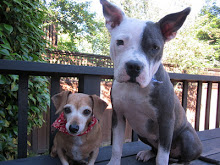
Samson (shown above middle) is a handsome brindle boxer who was born with a form of dwarfism. Like 90-95% of the dogs who arrive at Angel's Gate, he came from a puppy mill. Along with the other animals, Samson will be lovingly cared for for despite his disability. As Susan told Oprah, "What we do is make a commitment to the animal for a lifetime so that they know that they're never going to be abandoned. They're going to be loved the rest of their lives."

Susan gave up a lucrative job as a registered nurse 18 years ago, determined to care for "the misfits and the cast-offs of our society." With a new 100 acre location in upstate New York, world-wide acclaim, and the $50,000 grand prize from Rachael Ray's "Mutt Madness" contest, it seems safe to say that Susan has realized her goal with Angel's Gate. Best of all, her work has inspired countless others to open their hearts and homes to disabled animals. Click here to see a video clip of the Angel's gate animals in action (Samson included!).

Sunday, July 25, 2010

Yasko The Three-Legged Crime Fighter

Yasko the German Shepherd had the distinction of being only three-legged member of the Paso Robles, California police force. Although he was diagnosed with bone cancer last fall and had his left hind leg amputated, Yasko gamely returned to work on the canine unit within a month.

His human partner, Sgt. Tod Rehner, told the San Luis Obispo Tribune "He loves working. He doesn't know any different. To him, everything is the same as it always was."

Yasko was known for his stellar tracking abilities and regarded as a tireless detective. He knew approximately 20 police commands (all in German) and once tracked an armed suspect for 45 minutes until he successfully sniffed out his hiding place.

After his amputation, Yasko worked with Sgt. Rehner on narcotics detection. At the end of his shifts as a three-legged crime fighter, Yasko got to relax as a family dog at Rehner's home and play fetch with the kids.

Sadly, Yasko lost his brave battle with cancer in May, just two weeks before his eighth birthday and he is deeply missed by his colleagues on the Paso Robles police force. According to Sgt. Rehner, "Yasko was a great dog and a better partner."

Although this tripod's life was claimed by cancer, his legacy as a three-legged hero will endure. Yasko was living proof that pooches can and do adapt after loosing a limb, and can even carry on as professional working dogs.

Thursday, July 22, 2010

Greta's Story

Greta's story has been added to the www.blinddogs.net website! Click here to read more about our special senior girl, and don't forget that you can also submit the story of your own blind dog.

Monday, July 19, 2010

Thoughts About Pit Bulls


Sooner or later anyone who's involved with animal rescue must contend with the highly-charged topic of Pit Bulls and Bully breeds. Based on my time spent working in animal shelters, I have come to appreciate these misunderstood dogs for their exuberance, energy, and social personalities. Is every Pit Bull or Pit mix well-socialized and friendly? Of course not. But then again, neither is every Dachshund or Golden Retriever. In fact, the dog bites I have received have come from a Yellow Lab and a Chihuahua mix.

Still, no other type of dog provokes as much controversy, fear, and downright hysteria. I was reminded of this a few weeks ago at a cafe in Berkeley. Three-legged Dewey and I were seated at an outdoor table and, as usual, he was attracting his fair share of attention (my little tripod is quite adorable - it's true!). One woman was enthusing about her love for dogs big and small, when she leaned in conspiratorially and pronounced, "NOT Pit Bulls, though. I always cross the street when I see one coming."

On another recent occasion I saw a Boxer calendar in someone's office. I mentioned how cute it was and the woman responded by saying that she is a huge fan of Boxers and has one at home, but "unfortunately people often mistake them for Pit Bulls."
So, what's inherently wrong with Pit Bulls?

My answer: NOTHING! (Except for their undeserved reputations).

I recognize that many others vehemently disagree, however. Denver and Miami-Dade County have outright bans on Pit Bulls, and many other municipalities including Toledo, Sioux City, and Prince George's County, Maryland have stringent restrictions on Pit Bull ownership.

Livingston County, Michigan which is about 53 miles Northwest of Detroit, is an especially bad place to be a Pit Bull; legislation introduced in 2008 mandates that "No Pit Bull Terrier, American Pit Bull Terrier, American Staffordshire terrier, American Bulldog, mixes (AKA Bully breeds) or any aggressive animal will be adopted or placed from Livingston County Animal Control. Stray Bully breeds and aggressive animals will be held for the State mandated holding period (pending owner claim). If not claimed the animal will be humanely euthanized."

With so much restrictive legislation pertaining to Pit Bulls, it's imperative to address the many misconceptions that surround Bully breeds. Click here to see answers to the common "monster" myths from BAD RAP (Bay Area Doglovers Responsible About Pit Bulls).

One perennial concern about Bully breeds is that they are more likely to be aggressive and bite. The American Veterinary Medical Association's Task Force on Canine Aggression and Human-Canine Interactions released an extensive report about dog bites in 2001. In response to the question "Which Dogs Bite?" the AVMA panel released this answer:

"An often-asked question is what breed or breeds of dogs are most 'dangerous.' This inquiry can be prompted by a serious attack by a specific dog, or it may be the result of media-driven portrayals of a specific breed as 'dangerous.' Although this is a common concern, singling out 1 or 2 breeds for control can result in a false sense of accomplishment. Doing so ignores the true scope of the problem and will not result in a responsible approach to protecting a community's citizens."

Florida veterinarian Patty Khuly recently took in a severely neglected Pit Bull who had been confined to yard without food, shade, or water. The poor pooch didn't have any fur because of mange, so Patty christened her "Pinky" to reflect both her appearance and her "cotton candy disposition." Because Patty has first-hand knowledge of how wonderful Pits can be, she is an advocate against Breed Specific Legislation, or BSL. In a recent USA Today article, Patty addressed the misconceptions surrounding Bully breeds:

"The 'jaw locking' thing? A myth. Pit bulls' jaws are not anatomically or physiologically different from any other dogs' in this respect. Neither are pit bulls behaviorally special, save their infamous, terrier-ish drive to kill small prey. Indeed, anyone who owns a Jack Russell or bull terrier (of 'Spuds MacKenzie' fame) would recognize the same outsized drive."

In short, Pit Bulls really are just like any other breed - on an individual level, some are wonderful, well-adjusted dogs, while others are not. Our neighbor has a 12 year old Pit and he is as sweet as they come. I've lost count of the number of times Dewey has provoked him, and he always remains gentle and calm. Of course I don't expect every Pit Bull to be as unflappable as our neighboring pooch, but he is a perfect example of how sweet-natured these dogs can be.

The sad reality is that because Pitties have been so over-bred (especially in urban areas like Oakland), they generally constitute the majority of dogs entering animal shelters nationwide. Sadly, the chances are slim that they will leave alive. According to Doug Fakkema of American Humane, 58% of the approximately 1.7 million dogs euthanized in 2008 were Pit Bulls / Pit mixes.

In order to end this tragic cycle, we need to help confront the monster myths and adapt a more realistic, informed view of Bully breeds. Accessible spay/neuter programs are also key; animal shelters like the East Bay SPCA are leading the way on this front by offering free spaying and neutering for Pits and Pit mixes in our county, which is a hugely popular (and much needed) service.

To see some delightful Pit Bulls in action, check out the following links:


P.S. Angel, the beautiful girl shown at the top of this post, is available for adoption in Texas. Like all our favorite dogs, she is extra special - a bout with Distemper has left her with limited mobility. This doesn't stop Angel, though! In true Rebound Hound style, she gets around with determination and help from a special harness. Angel makes friends with everyone she meets (including kids and other dogs), and she would love to have a home of her own. Click here for adoption information.

Saturday, July 17, 2010

From Austin to Boston - On Foot!

Last year we learned about the 2,300 mile trek that Luke Robinson was undertaking with his two dogs, Hudson and Murphy, to raise awareness about canine cancer. Luke's two year journey from Austin to Boston was inspired by his late dog Malcolm, who fought a brave battle with osteosarcoma - a form of bone cancer that typically affects giant and large breed dogs like Great Danes, Saint Bernards, Newfoundlands, Bernese Mountain Dogs, and others.

One of Malcolm's front legs had to be amputated, but he was able to quicly adapt to life on three legs. Luke explains, "Within two weeks he had learned to balance his 120 pound frame without assistance, and not too much later, it was if he was born three-legged."

Malcolm spent several years as a tripod before succumbing to caner in early 2006. As a result, Luke decided to honor his beloved dog's memory by embarking on a journey to raise awareness about canine cancer and generate funds for research by the Animal Cancer Foundation.

It took two years and three months, but Luke and his faithful companions, Hudson and Murphy, finally walked the final mile into Boston last month! Check out the news clip below:


Thursday, July 15, 2010

Dog Days...


A wave of hot weather has hit us and the dogs (and humans!) are definitely feeling it.

Sunday, July 11, 2010

Three-Legged Dogs Lend A Paw To Robot Research

My brother-in-law, who works as an engineer and is always hip to the latest advancements in technology, recently sent me an article about a German robotics research project that involves tripod dogs. In order to improve robot efficiency and usability, the study is examining the walking / running patterns of European pooches with limb amputations, using a treadmill and infra-red cameras - fancy! For the complete story in Robo Daily, click here.

Wednesday, July 7, 2010

Blind Dogs See With Their Hearts

"Blind dogs see with their hearts" is the motto over at www.blinddogs.net, a wonderful website where families with sight impaired pooches share stories, tips, and resources, including a directory of board certified veterinary ophthalmologists. The profiles of individual dogs are diverse (some were born blind while others lost their vision over time, like our Greta, whose picture graces this post), but they all seem to share a commonality: being visually impaired does not destroy their quality of life!

In fact, the blind dogs community is quick to remind us humans that for dogs, eyesight ranks #3 in importance compared to smell and hearing. Although it's easy for us to focus on our own feelings of helplessness or pity when we encounter a disabled animal, our canine friends are far more resilient than we give them credit for.

Whether you're trying to cope with caring for a newly blind dog, or your pooch is getting up in years and you want to prepare for age-related vision loss, a visit to www.blinddogs.net will let you know that you're not alone.

Monday, July 5, 2010

Meet The Amazing Scuba Diving Dachshund!


Dachshunds are definitely talented dogs (especially when it comes to begging!), but Boniface is taking things to a whole new level. This little guy is learning to scuba dive with help from his human, Sergei Gorbunov. Boniface and Sergei live in eastern Russia and have been practicing their scuba skills in the Pacific ocean near the town of Slavyanka. Boniface is outfitted with a custom diving suit and seems to enjoy the underwater excursions.
_______________________________________________________

Photo credits: AP
The images show above are stills taken from TV, so they are a bit blurry.

Saturday, July 3, 2010

Patriotic Pooch

Have a safe and happy 4th of July with
your furry friends!