Friday, July 31, 2009

What You Need To Know About Canine Cataracts


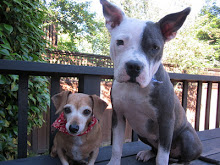
If you share your home with a senior dog, there's a good chance that your old timer will encounter vision impairment at some point. Cataracts often appear in geriatric dogs and are one of the leading causes of canine blindness. A cataract is an opacity on the lens of the eye. Although these opacities may start small, they usually progress to the point where the entire lens is clouded and all functional vision is lost (this was the case with our Greta, shown above). For affected animals, seeing through a mature cataract is comparable to looking through white frosted glass.

Cataracts can develop as the result of disease, trauma, genetics, and old age. The majority of dogs diagnosed with diabetes will develop cataracts. This is because the glucose concentrations in the lens increase as a result of the diabetes. Eventually the extra glucose is converted into sorbitol, which in turn leads to an influx of water to the lens. The added water contributes to a breakdown of the lens fibers and facilitates the formation of cataracts. If your dog receives a diabetes diagnosis, it's imperative to seek veterinary guidance about the accompanying vision concerns.

Canine cataracts can be treated by surgically removing the clouded lenses and replacing them with artificial ones. A veterinary ophthalmologist can evaluate your dog and let you know if s/he is a good candidate for surgery (for Greta, we decided that she's been through enough medical ordeals for one lifetime, so we're not pursuing cataract surgery). The American College of Veterinary Ophthalmologist' website has a nationwide directory of providers.

If you suspect that your pooch may be developing cataracts or another vision disorder, here are several signs to be aware of:
  • A tendency to bump into things
  • Reluctance to use stairs or jump on or off furniture
  • Hesitancy in unfamiliar environments
  • Bluish, gray or white color change inside of the eye (in many instances discoloration may be due to a benign geriatric condition called Nuclear Sclerosis which does not impair vision, but it's still advisable to have a vet examine any animal with discolored eyes)

For more information about canine cataracts, click here.

Tuesday, July 28, 2009

Heartwarming Story Of The Week: "Canine-do Attitude Drives 2-legged Dog"


This wonderful story about Dare, a 2-legged puppy mill survivor, recently appeared in the Dever Post. I hope that you all enjoy it as much as we did!

Canine-do Attitude Drives 2-legged Dog
By Adam Schrager

Among Tami Skinner's three Shelties, it's easy to pick out the youngest. He's not just the smallest or the one knocked down by his brothers while playing catch in her backyard. Three-year-old Dare has a more obvious distinction. He has only two legs — the front and back limbs on his right side.

"People ask me all the time, 'How does he walk?' " said Skinner. "He just walks. He just goes because nobody's told him he can't."

He has adapted to life with half the capacity of a normal dog without giving up anything in the process. For example, he leans against a wall to drink his water and eat his food. He uses the ground to help balance any bone he wishes to chew. And when he plays with his brothers, he'll get tired from running a little quicker and lie down to rest before using his two limbs to push himself up and get back in the game.

"I've never treated him as a disabled dog," Skinner said. "He's special, but he's not disabled."

Skinner likes to tell people that Dare stands for Daredevil. But the truth is that Colorado Sheltie Rescue, which saved him, wanted to dare people to see his face and hear his story before they would deny the reality behind the puppy mill where he was born. His back left leg was chewed off before he was a week old, and his front left leg was caught in a cage, fractured in multiple places and dislocated at the elbow. After receiving no medical treatment for weeks, he was given up by the breeder because no one would buy him.

"I can't even imagine how much pain he was in," Skinner said. "(Yet) he has the attitude 'I can do anything (other dogs) can do.' . . . He has a spirit you cannot deny."

From the moment she adopted him, Skinner knew Dare's purpose transcended simply playing with a tennis ball and that her obligation to him transcended carrying him outside to go potty.
They became an animal-therapy team through the American Humane Association and travel the Denver metro area to bring support, comfort and inspiration. At the King Adult Day Enrichment Program, Rochelle Rotruck dropped her pottery clay — which she had been kneading to help joints stiffened by multiple sclerosis — to embrace her "grand baby." He visits the Denver facility weekly.

"He gives you an incentive to try and do better no matter your disability," Rotruck said, holding Dare on her lap. "Like the day I was feeling sorry for myself because of my (joints), and then Dare came in and I forgot all about it."

Every other week, Skinner takes him to the Fletcher-Miller School in Jefferson County for special-needs children. She reads to the class, and Dare sits on kids' laps — and when he starts licking faces, there's not a frown to be found.

"He's just like them," Skinner said. "He accepts them for who they are and doesn't treat them any differently because of their disabilities."

Once a month, he visits an amputee clinic at Presbyterian St. Luke's, where patients share stories about the loss of an arm or a leg.

"A lot of times, we can accomplish more than we thought we could," said Dr. Howard Balan, a psychologist who facilitates the group. "(Dare) tries and tries and tries, not knowing he should stop trying. I doubt Dare has these obstacles in his own mind, while we humans, we can put these obstacles right in front of us."

Skinner says the overall message Dare can share is this: In a world where there are all sorts of reasons to complain about our lot in life and to stress out about trying to solve our problems, if a two-legged dog can figure it out and live a happy life, so can we.

"I look at him and think, nothing I have ever experienced in life, ever, has met up with what he has experienced in life," she said. "And he's happy, wrestling, playing with his brothers like nothing's wrong, so why am I being a sourpuss?

"Get on with life, enjoy it. You only get one."

Friday, July 24, 2009

The Rebound Hounds' Summer Reading Suggestions & Book Give Away!


With the dog days of summer officially here, there's no better time to stretch out your paws in a shady spot and enjoy a good book. Here are our summer reading suggestions for dog lovers everywhere:

Since The Bark is our favorite canine magazine, it came as no surprise that we fell head over heels for Dog Is My Co-Pilot: Great Writers On The World's Oldest Friendship, a 2004 book of essays collected by The Bark's editors. The anthology is arranged into four sections - Beginnings, Pack, Lessons, and Passages - and features wonderfully compelling essays by Caroline Knapp, Pam Houston, and Margaret Cho among others. From Stephen Kuusisto's unique and touching account of meeting his guide dog Corky for the first time, to Ann Patchett's lovely ode to her rescue pup Rose, Dog Is My Co-Pilot is the type of book that will keep you up late, happily turning pages.

My one criticism lies with the small group of contributors who chronicled their purchase of dogs from breeders. Alice Walker's essay was (surprisingly) the most offensive to me; even after evoking images of the slave trade and acknowledging that "it didn't feel right to pay money for a living being," Walker went ahead and bought a black Lab puppy anyway. Fortunately, Catherine Ryan Hyde's short story about an Argentine immigrant who opposes his neighbor's treatment of his $2,000 purebred Doberman watchdog, is good enough to compensate for the minority of flawed essays in Dog Is My Co-Pilot.

For the kids in your life (and the young at heart), we recommend How Willy Got His Wheels - the uplifting true story about our paraplegic friend Wheely Willy. After the little Chihuahua is rescued by Deborah Turner, she works tirelessly to help him regain his mobility. How Willy Got His Wheels won the 1998 Best Children's Book Award from the Dog Writers Association of America, and has earned rave reviews from parents for teaching empathy and kindness.

We first discovered animal behaviorist Dr. Patricia McConnell on the Public Radio program "Calling All Pets" and have been ardent fans ever since. McConnell is brimming with information and insight, and her brilliant book The Other End of The Leash is a must for anyone who shares their life with dogs. The chapters are organized by senses including sight, sound, and smell with the purpose of explaining the differences between canine perception and human perception. McConnell shares the science behind our differing interpretations of nonverbal cues like eye contact (a show of confidence and affection for us, but a display of aggression for our pups), without being dull or dry. After reading The Other End of The Leash, you'll be amazed by your dog's ability to decode your confusing human body language!

To inspire everyone to delve into some canine-minded reading this summer, we are giving away a copy of Almost Perfect: Disabled Pets And The People Who Love Them. Edited by Mary A. Shafer, Almost Perfect features 11 inspirational true life "tails" about special needs pets. To win your free copy, email us at reboundhounds@yahoo.com to share the rescue story of your less than perfect pet. Greta and Dewey will select their favorite entry for the blog and the winner will receive a copy of the book. Ready, set, read!

Wednesday, July 22, 2009

Give A Dog A Bone

Few things in life make three-legged Dewey happier than a good bone. The smile on his face says it all!

Thursday, July 16, 2009

Meet Wheely Willy

Wheely Willy is BIG in Japan. And California, too. He's charmed hundreds of students and hospital patients across the U.S. and abroad. With his posh assortment of outfits and accessories, he turns heads wherever he goes. Wheely Willy is the subject of an award-winning children's book and has been featured on Animal Planet. At 19 years young, this paralyzed Chihuahua is an amazing "ambassadog" for disabled canines everywhere! Learn more about Wheely Willy's remarkable rescue story by clicking here.

Friday, July 10, 2009

Annika To The Rescue (Or, How I Spent The 4th Of July)


Holiday weekends are bound to make you nervous if you subscribe to Murphy’s Law and work at an animal shelter like I do. Despite being an optimist at heart, I must confess that I was apprehensive when July 4th rolled around. Although I anticipated an unforeseen predicament or two, I had no idea that I was going to encounter a full-blown crisis involving a sick puppy, a courageous pit bull, and a life-saving midnight mission to an emergency clinic.

The day stated out quite normally at work, with cleaning and animal care taking all going according to plan. It wasn’t until after lunch that a member of our canine team noticed that one of the 9 week old “Dinosaur” puppies named Pterodactyl was bleeding. A closer examination reveled that his neuter incision had opened up. Since the SPCA clinic was closed for the holiday, there was no choice but to take Pterodactyl to an outside animal hospital for treatment. Several hours later, the little Shepherd mix was bandaged up and ready to return to the shelter. Still, I decided to take him home with me that evening just in case…

Fast forward several hours: “Just in case” turned into a life or death emergency. I was holding Pterodactyl when I realized that my shirt had become stained with blood. Looking down, I discovered that his bandage was completely soaked and he was hemorrhaging at an alarming rate. As fireworks began to illuminate the sky, we abandoned our BBQ and raced the tiny pup back to the 24 hour vet clinic where he was immediately whisked into an operating room. When it came time to give a prognosis, the doctor on call didn’t mince words; Pterodactyl was dangerously close to death and would need a blood transfusion in order to survive. He might make it if we could round up a 50+ pound donor dog – fast.

Within 15 minutes, I was back at the shelter racing past kennels of sleeping dogs in search of one who could save Pterodactyl. When I caught sight of Annika, a good-natured pit bull curled up on her Kuranda bed, I knew she could rise to the occasion, and she did. Despite being groggy and slightly confused, Annika donated blood without sedation like a true champ. The clinic staff declared her to be “a genuine sweetheart” and rewarded her with a hearty midnight snack.

Exhausted and knowing that I had done all that I could for the time being, I headed home to get a few hours of sleep before I was scheduled to reopen the shelter in the morning. At around 3:00 am, Michael nudged me awake with news from the vet: Thanks to the transfusion from Annika, Pterodactyl had pulled through surgery and was in stable condition. I was far too tired to adequately express my joy, but I was flooded with an overwhelming sense of gratitude and relief.

Earlier today at the shelter, we set aside some time to introduce Annika to the little shepherd pup whose life she saved. They were nuzzling within seconds like long lost friends! Although the dogs can’t fully comprehend their connection to one another, they are now inextricably linked. The name Annika has Hebrew roots and means “grace” or “graceful one.” This seems especially appropriate in light of her unexpected heroism on the night of the 4th.

Fortunately I won't have to contend with anymore holiday weekends for a while, but I'm bound to have dramatic work stories to share. Stay tuned for more adventures in animal sheltering!

Wednesday, July 8, 2009

Three-legged Pogo Is A Dock Diving Virtuoso


When Jim Allen first saw a dog dock diving competition two years ago, he wasn't sure if his three-legged pooch, Pogo, could swim, let alone dive. Out of curiosity, he decided to introduce Pogo to the water. This led to the exciting discovery that his tripod dog is an aquatic virtuoso!

Despite being born with three legs, Pogo not only loves to swim, she is also a canine dock jumping champ. Together with two other dogs, Rogan and Molly MacGuire, Pogo now travels around the Midwest competing in diving / jumping tournaments. Jim christened the group "Team Second Chance" since all three dogs were rescued.

This week they are putting their best paws forward at the National Cherry Festival in Traverse City, Michigan - a place we know well since my grandmother lived there for many years. Here's hoping that Pogo "The Three Legged Wonder" is the next Ultimate Air Dog!

P.S.
Speaking of tripod dogs being able to swim, we still don't know if Dewey can. He paddles around the bathtub a bit, but we've never seen him in deep water to know how he would respond. Does anyone have experience testing their tripod's swimming capabilities?

Friday, July 3, 2009

Deaf Dog Advocacy & Education

"A deaf dog is a dog first, a breed second, a personality third, and deaf last." This insight is from an article provided by a great advocacy organization called D2Care. Founded in 2006, D2Care is committed to providing education about deaf dogs and dispelling the many myths that prevent them from being adopted. On the D2Care website there are all kinds of helpful reading recommendations, along with links to dog body language diagrams, American Sign Language dictionaries, and more.

The majority of D2Care members have deaf dogs themselves, and they are quick to point out that canine deafness is only regarded as a fault from a human standpoint. Here is an excerpt from one of D2Care's articles by T.E. Houston:

"Deafness is viewed as a problem because the major human communication line between the dog and the owner is disrupted. When we speak to (or yell at) our dogs, we expect them to respond... Despite that, our body language speaks volumes: our stance, facial expression, hands, gestures, eyes - our whole body 'speaks.' Our dogs are very attuned to this non-verbal form of communication. The dogs respond not just to the words we speak, but to our body language, maybe even more so than the words. Our dogs 'read' us far better than we can read them."

In addition to sharing educational resources with dog guardians, D2Care is also committed to providing funding for deaf dogs in need. Over the past several years, the organization has paid for several air transports of deaf dogs, including the adorable Great Dane puppies pictured above. Despite being slated for death because of their deafness, these lovely girls are now thriving in loving homes due to the heroic efforts of D2Care!